Scenario 3:
The Divided Democracy
Unequal AI adoption fragments global landscape
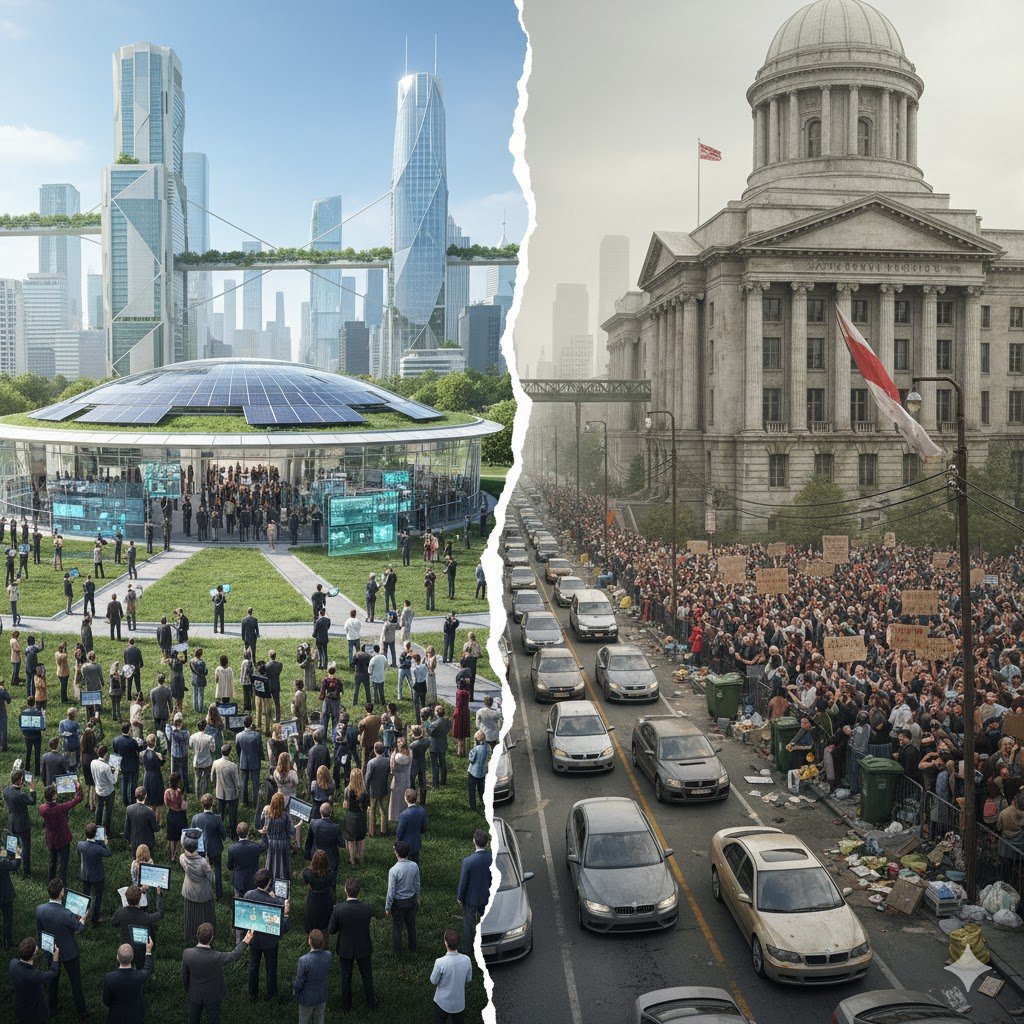
In this challenging future, the global parliamentary landscape has fractured along technological lines. A stark digital divide separates "AI-advanced" parliaments (typically in wealthier nations) from "AI-limited" ones (often in developing regions). While the former leverage sophisticated AI for hyper-efficiency, vast public engagement, and robust oversight, the latter struggle with outdated infrastructure, limited capacity, and reliance on traditional, slower processes. This creates a two-tiered democratic system, exacerbating global inequalities, limiting effective international collaboration, and fueling public frustration in lagging nations.
Examples:
"Holographic Town Halls" vs. Paper Petitions: Citizens in an AI-advanced capital participate in "holographic town halls," with their real-time feedback immediately processed by AI for parliamentary consideration. Simultaneously, in a less resourced capital, citizens queue to submit hand-written paper petitions, knowing their voices will be slow to reach decision-makers.
Legislative Analysis Gap: An AI-advanced parliament uses AI to analyze thousands of pages of complex international trade agreements in minutes, identifying potential legal pitfalls and economic impacts. A parliament in an AI-limited nation, relying on human-intensive analysis, takes weeks to review a fraction of the text, often missing crucial details and struggling to negotiate effectively.
Information Asymmetry: During a global crisis, AI-advanced parliaments rapidly synthesize information from vast datasets, anticipating geopolitical shifts and public sentiment. AI-limited parliaments, lacking these tools, are reactive and often misinformed, making them vulnerable to disinformation campaigns and less effective in international forums.
Citizen Disenfranchisement: Citizens in AI-limited countries become increasingly disengaged from their parliaments, viewing them as slow and unresponsive. They may turn to non-state actors or rely on social media platforms for information and organization, further eroding trust in formal democratic institutions.